
Species composition and co-occurrence patterns of ant assemblages in Coccoloba uvifera shrubs of two sandy beaches
Article Sidebar
Main Article Content
Abstract
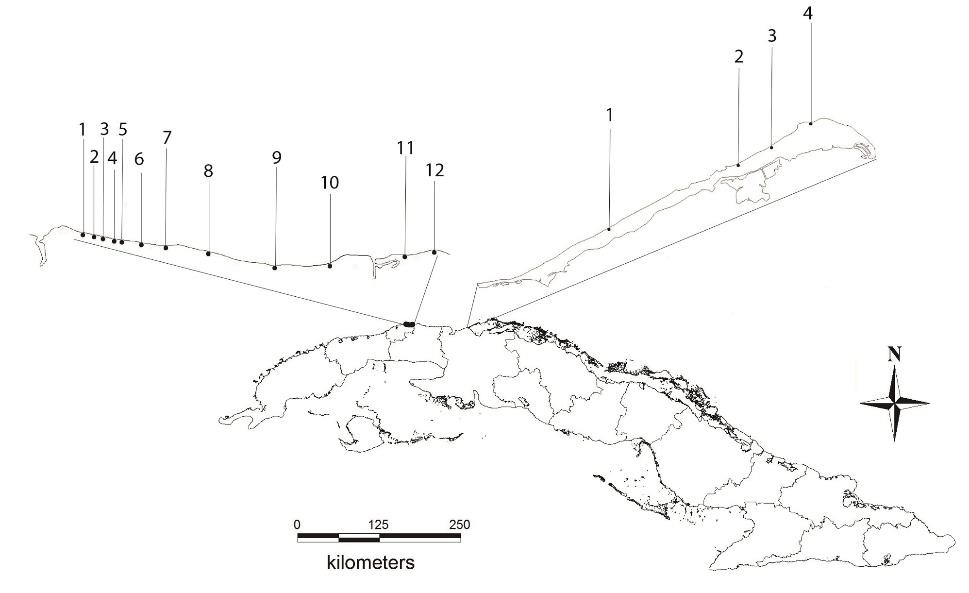
Ants are one of the most important animal groups in terms of biomass and local abundance, and have been poorly studied in coastal dunes systems. The sea-grape shrub Coccoloba uvifera provides shelter and resources, such as nectar, fruits, “honey dew” of scale insects, and the leaf-litter supplies organic matter and retains humidity. The goal of this paper is to assess species composition and co-occurrence patterns of ant assemblages in sea-grape shrub formations along two sandy beaches in the northern coast of Western Cuba. There were determined, during the years 2017-2018, 21 ant species from 240 1x1m quadrats at Eastern Beaches and 13 species from 80 quadrats at Varadero Beach, for a total of 23 ant species. The most frequent species were Wasmannia auropunctata, Pheidole megacephala and Paratrechina longicornis. The predominant functional groups were the dominant omnivorous of ground and vegetation, and ground and vegetation opportunists. Both ant assemblages showed equivalent proportions of shared species and similar values in species richness and diversity. It was observed a nested general pattern of species composition across quadrats. Species co-occurrence and species combinations were less than expected by chance alone. The highest scores for negative interactions at the two beaches corresponded to the pair Pheidole megacephala-Wasmannia auropunctata, and for positive associations to the pair Paratrechina longicornis - Dorymyrmex pyramicus and Paratrechina longicornis - Brachymyrmex obscurior. It is concluded that both ant assemblages exhibited similar ecological structure.
Article Details
Section
Los resultados publicados en la revista Poeyana se presentan bajo la Creative Commons Attribution License, que permite a cualquier lector hacer un uso libre de estos mientras refiera la fuente. No debe, por tanto, incluirse ningún material que no pueda ser publicado bajo estos términos, por ejemplo, fotografías con Copyright. Todos los datos o materiales extraídos de un trabajo escrito por otra persona, se deben identificar con claridad y atribuirse a sus autores, aunque no se hayan publicado o no se hayan citado palabra por palabra.